
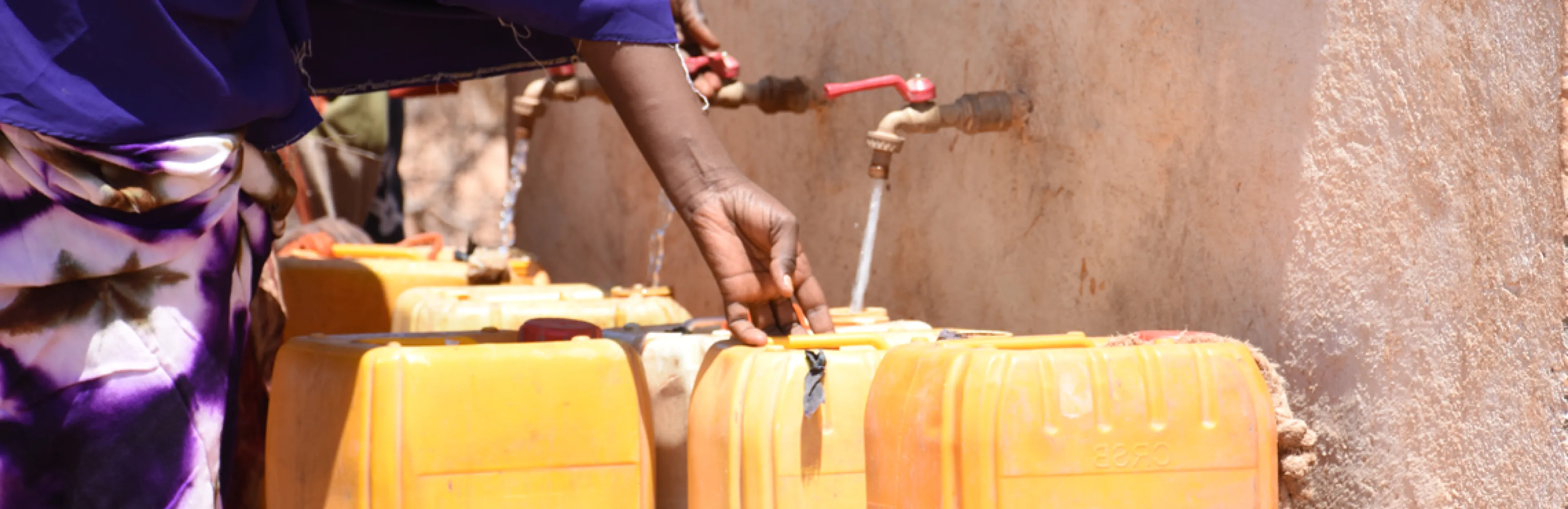
In East Africa, the EU - together with local authorities, Member States, and NGOs - is ensuring access to safe water and expanding sanitary facilities to help local communities overcome the pandemic.
Somalia |
 Issack Liban © European Union/Mohamed Maslah, 2019 |
Meet Issack Liban. He’s a 56-year-old chief from Abore village, in the remote Gedo region of Somalia. The EU is funding the construction of a new water well and the installation of a pipeline system, generator and pump to help Issack’s village. |
“You can rest assured that we will take care of this water source as if our lives depended on it since they literally do.”
It’s part of the building opportunities for resilience in the Horn of Africa (BORESHA) project, funded by the EU and implemented by the Danish Refugee Council and other NGOs.

BORESHA workers in Somalia © European Union/Mohamed Maslah, 2019
The construction helps the community keep on top of handwashing and good hygiene practices, and has been instrumental in combating the spread of coronavirus.
But the benefits have gone far beyond that. The new water source has proved to be a lifeline for the 175 households of the village, giving the locals a sufficient supply of clean water for household and livestock use.
More cleaning and bathing reduces the spread of illness and waterborne diseases. Children, especially girls, can dedicate more time to their education as they’re spending less time fetching water. And, in general, less time is spent on domestic duties, which means less work and a better quality of life for women.

Local woman and BORESHA project manager in Somalia © European Union/Mohamed Maslah, 2019
The BORESHA project is also active in Ethiopia and Kenya. Thanks to its support, over 9,000 people across the three countries now have access to clean water close to home.
“I worried about water more than anything else in my life. It has been so long since I saw clean water in my village, it’s like a miracle to be honest.”
Kenya |
The EU is working with partners to give more people access to clean water and to build better sanitation facilities in 25 pandemic hotspots around Kenya.
Foot-operated hand washing stations have been set up in market centres, health institutions, police stations and military barracks.

Woman using the mobile handwashing station in Kenya © Water Sector Trust Fund, 2020
And there’s no worry about these mobile sanitation units running out of clean water, either. Huge water tanks have been delivered across the country - some of them are twice the size of a human and can hold up to 10,000 litres. Soap has been distributed widely, too, and lots of information is being shared on how good hygiene can combat the spread of the virus.

Local officials in front of a water tank in Kenya © Water Sector Trust Fund, 2020
It’s part of the Union’s “Covid-19 Support Programme,” which has mobilised €1.8 million together with Denmark, Finland and Sweden. On the ground, the programme works with local public health officials and state-owned Water Sector Trust Fund (WaterFund), as well as with community health workers and volunteers.
Overall, it’s estimated that almost 120,000 people living in urban low-income areas will benefit from this support.
Edwin Tanui is a secretary at the Kenyan Koitegan Community Forest Association. For him, the communal water dispenser donated by the project is a great gesture.
“During this pandemic, the best we can do is to observe hygiene, wash hands, keep distance and put on face masks,” says Edwin Tanui.
The EU has a long history of working together with Kenya to overcome challenges, such as food security, environmental disasters, and the management of millions of refugees that have sought shelter in the country over recent years.
And the coronavirus pandemic has proved no different. Currently the EU and its countries are redirecting their funding to areas where it is critically needed in response to the pandemic. This means that a lot of it goes on access to water and sanitation, to help local communities control the crisis and make them more resilient in case of future outbreaks.
We will only successfully recover from this pandemic if our partners around the world recover, too.

The local community in front of a water tank in Kenya © Water Sector Trust Fund, 2020