
What if you are facing an emergency while taking a trip to a country outside the EU? As an EU citizen, you are entitled to seek help from the embassy or consulate of any other EU Member State if you need assistance in a country outside the EU where your own EU Member State does not have an embassy or consulate (you are ‘unrepresented’). This is one of your fundamental rights as an EU citizen. The embassy or consulate from another EU Member State must help you in the same way as they would help their own nationals.
Consular protection outside the EU
An EU citizen is unrepresented if there is no embassy or consulate from his or her own Member State present in the country. An EU citizen can also be unrepresented if the embassy or consulate established locally is unable for any reason to provide consular protection, for example because it is far away from where the EU citizen is located.
Check this EU website to find whether your own EU Member State has an embassy or a consulate in the country where you are travelling. If your country is not represented, the website provides the contact details of embassies and consulates of other EU Member States that you might wish to contact to seek assistance.
The help that may be provided by embassies/consulates of (other) EU Member States include assistance in cases of:
- Lost or stolen passport or ID card: the embassy can issue an emergency travel document – single-journey documents intended to allow you to return home.
- Arrest or detention: once contacted, the embassy may provide information on the local legal system, or help you find a lawyer.
- Being victim of a crime: someone from the embassy may assist you and advise on the next steps.
- Serious accident or illness: staff may help contact your insurance company, family, or friends for you if you end up in hospital.
- Relief and repatriation in case of an emergency: the embassy may be able to help be evacuated, for example in case of a conflict, a natural disaster or civil unrest.
- Death: Staff may help notify next of kin and help you register a death.
When unrepresented EU citizens seek help from the embassy or consulate of another EU Member State, they must prove their identity by showing a passport or identity card. If their documents have been stolen or lost, their nationality can be proven by other means, including by verification with the authorities of their EU Member State of nationality.
Unrepresented citizen should be duly taken into account and fully assisted in crisis situations, where a clear division of responsibilities and coordination are of paramount importance. The Consular Crisis Management Division of the European External Action Service assists in coordinating action in times of crisis.
For more information, visit the website on consular protection for EU citizens abroad. To see whether your Member State has an embassy or consulate in the country where you are, visit the section Find an embassy/consulate. To find out more on how the EU Member States work together on consular issues, visit the Council’s website on consular protection.
EU Emergency Travel Document
A special form of consular assistance is the issuance of emergency travel documents, for example in case of loss or theft of a passport. A new EU Emergency Travel Document is in place as of 9 December 2025. It has an updated format and stronger security features, introduced by the 2019 Directive on an EU emergency travel document. The Commission, the European External Action Service (EEAS) and the global network of EU Delegations have provided information on the new EU Emergency Travel Document to countries around the world. Information on the new EU Emergency Travel Document are also available on the website of the EEAS.
What is the EU Emergency Travel Document, and who will receive one?
The new EU Emergency Travel Document is issued by EU Member States to EU citizens whose passport or travel document has been lost, stolen or destroyed in a country outside the EU where their own EU Member State does not have an embassy or consulate.
Who else can receive an EU Emergency Travel Document?
Member States may also choose to issue the EU Emergency Travel Document to other persons, such as:
- their own nationals
- EU citizens who lose their travel documents in the EU, or based on specific arrangements between EU Member States
- non-EU national family members of EU citizens, where those family members live in the EU
- other persons to whom an EU Member State is obliged under international or national law to provide protection and who live in the EU.
For how long is an EU Emergency Travel Document valid?
The EU Emergency Travel Document is valid for a single journey to the holder’s Member State of nationality or residence, or exceptionally, to another destination (such as a neighbouring country with an embassy or consulate of the holder). The holder of an EU Emergency Travel Document is strongly encouraged to complete the journey as quickly as possible and to immediately apply for a normal travel document.
The EU Emergency Travel Document is valid for the period required for completion of the journey for which it is issued, including an additional grace period of two days. Save in exceptional circumstances, the validity must not exceed 15 calendar days
How is the EU Emergency Travel Document issued?
EU citizens who need an EU Emergency Travel Document must apply at the embassy or consulate of an EU Member State. They will be asked to provide information necessary to identify them (including any available documents, such as an identity card or driving license) as well as a photo.
An EU Emergency Travel Document is issued after a verification of the applicant’s nationality and identity between the EU Member State providing assistance and the unrepresented EU citizen’s Member State of nationality. In normal cases, the issuance should not take longer than seven working days.
The EU Member State issuing the EU Emergency Travel Document may charge the same fees as it charges its own nationals for the issuance of national emergency documents. This means that the fees will differ depending on which EU Member State is issuing the document.
When the EU Emergency Travel Document is issued, the person receiving it will be asked to return the EU Emergency Travel Document upon arrival at the final destination. The EU Member State issuing the EU Emergency Travel Document will provide information as to where the document should be returned.
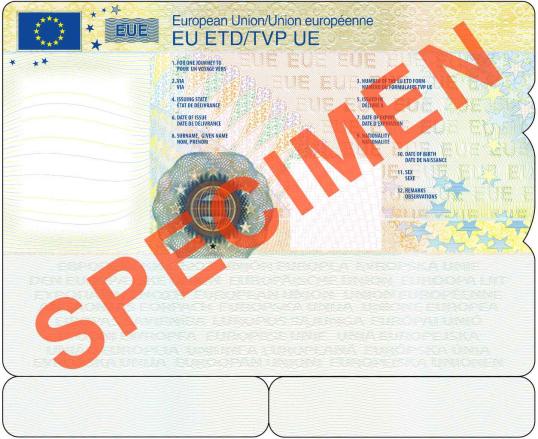
What does an EU Emergency Travel Document look like?
The EU Emergency Travel Document consists of a sticker and a passport-size booklet, which look like this:


Development of EU consular protection
The right to consular protection for unrepresented EU citizens is set out in Articles 20(2)c and 23 of the EU Treaty and Article 46 of the EU Charter of Fundamental Rights.
The Commission adopted a proposal to amend the Consular Protection Directive 2015/637 on consular protection for unrepresented European citizens living or travelling outside the EU.
The proposal which will strengthen the right of EU citizens to consular protection, especially in crisis situations, draws on recent experiences, including the consular impacts of the COVID-19 pandemic, Russia’s war of aggression against Ukraine, and the repatriation of EU citizens from Afghanistan and Sudan.
The Directive makes cooperation between consular authorities easier and strengthens EU citizens' right to consular protection. This is particularly important in crisis situations (for example in the case of a natural disaster or armed conflict). Member States represented in a non-EU country should coordinate contingency plans among themselves and with the EU Delegation to ensure that unrepresented citizens are fully assisted in the event of a crisis.
In parallel, the Commission continues to include and negotiate consent clauses in bilateral agreements with third countries to ensure that these countries agree that represented EU Member States give assistance to unrepresented EU citizens.
In September 2022, the Commission published a report on the on the implementation and application of the Consular Protection Directive.
Further reading
Proposal to amend the Consular Protection Directive
Report on the implementation of the Consular Protection Directive
Directive on an EU Emergency Travel Document
Technical specifications for the EU Emergency Travel Document
1996 emergency travel document Decision
Communication on consular protection 2011
Action Plan of December 2007
Green Paper of November 2006

- Консулска закрила за гражданите на ЕС
- Protección consular para los ciudadanos de la UE
- Konzulární ochrana pro občany EU
- Konsulær beskyttelse for EU-borgere
- Konsularischer Schutz für EU-Bürgerinnen und Bürger
- Konsulaarkaitse ELi kodanikele
- Προξενική προστασία των πολιτών της ΕΕ
- Protection consulaire des citoyens de l’UE
- Konzularna zaštita za građane EU-a
- Protezione consolare per cittadini e cittadine dell’UE
- ES pilsoņu konsulārā aizsardzība
- Konsulinė apsauga ES piliečiams
- Konzuli védelem uniós polgárok számára
- Consulaire bescherming voor EU-burgers
- Ochrona konsularna obywateli UE
- Proteção consular para cidadãos da UE
- Protecția consulară pentru cetățenii UE
- Konzulárna ochrana pre občanov EÚ
- Konzularna zaščita za državljane EU
- EU-kansalaisten konsulisuoja
- Konsulärt skydd för EU-medborgare