
Our response to Russia's war of aggression against Ukraine has been clear, and it must be a lasting one.
Our efforts to work for a just peace:
- Providing help and support to the people of Ukraine
- Helping maintain critical infrastructures in Ukraine
- Providing solidarity to Ukraine, making full use of the EU's economy and finance
- Helping Ukraine defend itself, supplying military equipment to Ukraine and training Ukrainian soldiers
- Holding Russia accountable and imposing sanctions to weaken Russia's war machine
- Reconstruction and supporting Ukraine's European path

Providing help and support to the people of Ukraine
In a historic first, only days after the start of the Russian invasion, on 4 March 2022, the EU brought the Temporary Protection Directive into effect. Ukrainian refugees were granted rights within the EU, including residence permits, access to the labour market, housing provisions, medical care, and vitally, educational opportunities for children.
EU Member States have opened their homes and hearts to millions of Ukrainian refugees of war, offering temporary protection to approximately four million individuals.

Text version
- More than 5 million individuals internally displaced within Ukraine
- Almost 20% of Ukraine’s children have found a safe haven in EU
Text version
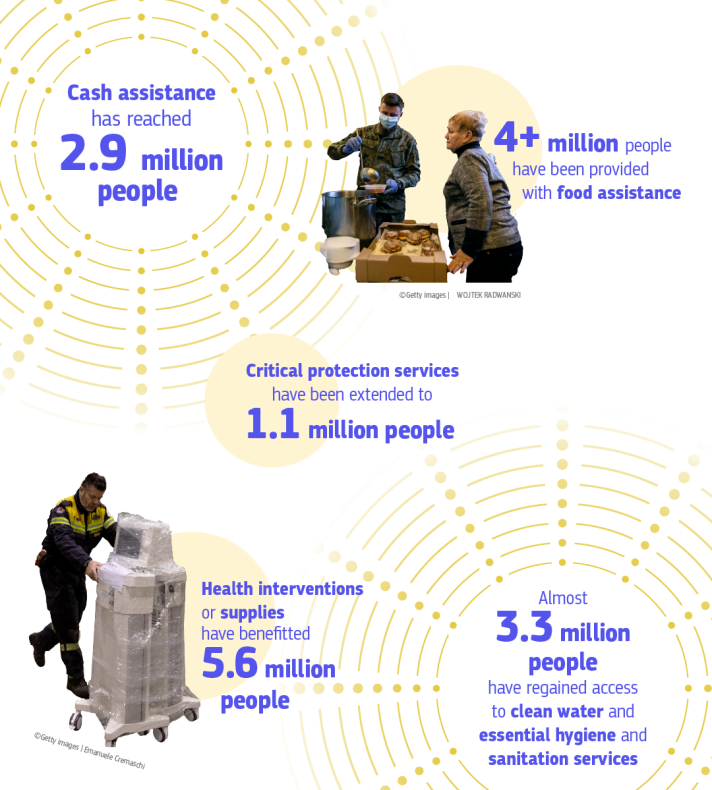
Since January 2023:
- Cash assistance has reached 2.9 million people
- More than 4 million people have been provided with food assistance
- Critical protection services have been extended to 1.1 million people
- Health interventions or supplies have benefitted 5.6 million people
- Almost 3.3 million people have regained access to clean water and essential hygiene and sanitation services
Supporting refugees fleeing the war
The CARE initiatives (Cohesion’s Action for Refugees in Europe and Flexible Assistance to Territories) introduced extensive flexibilities in the Cohesion Policy, allowing for the reprogramming of up to €17 billion of 2014-2020 unallocated funds to support people fleeing the Russian invasion.
EU Civil Protection Mechanism
Through the activation of the EU Civil Protection Mechanism, the EU has efficiently channelled aid to Ukraine from all 27 EU countries, as well as Iceland, North Macedonia, Norway, Serbia and Türkiye.
Text version
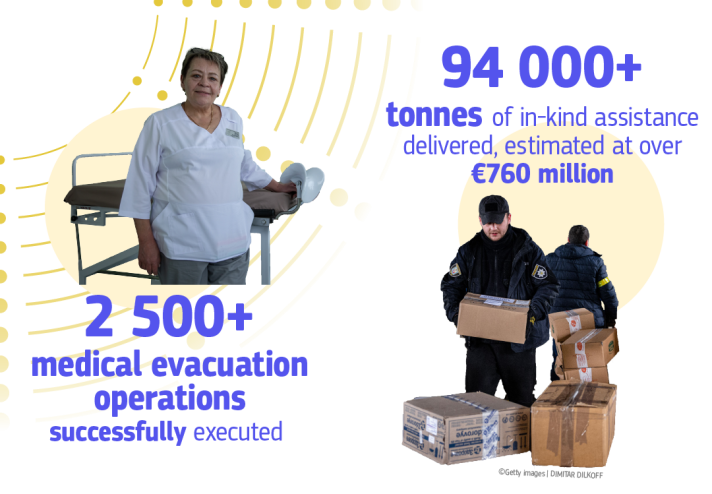
- More than 2 500 medical evacuation operations successfully executed
- More than 94 000 tonnes of in-kind assistance delivered, estimated at over €760 million
Making full use of the EU's economic and financial strength
The EU-Ukraine Solidarity Lanes have facilitated the export of a staggering 49 million tonnes of Ukrainian agricultural products. These vital corridors not only ensure the export of agricultural goods but also the import of requisite commodities. The total trade value realised through this corridor is estimated to be around €99 billion.
In February 2023, a landmark pact was inked between the Commission and Ukraine, associating Ukraine with the Single Market Programme, an endeavour designed to facilitate market access, foster a conducive business environment, and stimulate long-term sustainable growth.
Text version
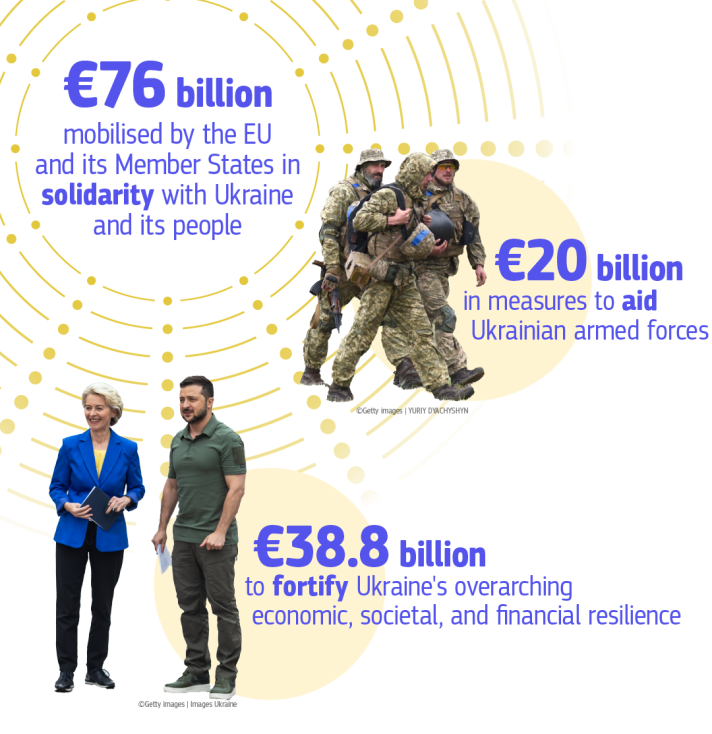
- €76 billion mobilised by the EU and its Member States in solidarity with Ukraine and its people
- €38.8 billion to fortify Ukraine's overarching economic, societal, and financial resilience
- €20 billion in military assistance measures to aid Ukrainian armed forces
- 2023
The EU is providing a support package for Ukraine of up to €18 billion, in the form of highly concessional loans. Thanks to this, Ukraine is able to keep paying wages and pensions and maintain essential public services, such as hospitals, schools, and housing for relocated people. It also helps ensure macroeconomic stability and restore critical infrastructure destroyed.
- 2022
The EU channelled €7.2 billion in macro-financial assistance to ensure the continuous operation of Ukraine’s government and public services.
Maintaining critical infrastructures
Nuclear safety
Since Russia continues putting civil nuclear installations at risk, the EU has provided Ukraine with more than €54.8 million in nuclear safety-related material assistance from the rescEU strategic reserve, such as restoring equipment and laboratories.
Energy
In response to Russia's brazen attacks on Ukraine's energy infrastructure, emergency measures were swiftly undertaken. Already early in the war, the EU made a decisive move to stabilise the electricity systems of Ukraine and Moldova, synchronising their electricity grids with the continental European Grid.

Telecoms
The European Commission successfully negotiated with EU and Ukrainian telecom operators to allow Ukrainian refugees to use their mobile phones with minimal or no roaming charges for a period of three months. In addition to making roaming affordable, the EU distributed 2.5 million SIM cards to Ukrainians seeking refuge and established Wi-Fi hotspots at border points and shelters.
The European Peace Facility, with its funding of €5.6 billion, has enabled the delivery of tanks, helicopters, air defence systems, missiles, and ammunition.
The EU Military Assistance Mission in support of Ukraine has trained more than 25 000 Ukrainian soldiers. We are on a steady path towards our target of fully training 30 000 Ukrainian soldiers by the year's end.
In July 2023, the Act in Support of Ammunition Production (ASAP), entered into force. This Regulation will see specific, targeted measures to boost production and ensure a secure supply of ammunition within Europe.
The EU bolstered Ukraine’s cyber resilience with an investment of €10 million towards equipment, software, and other related support.
Holding Russia accountable
Currently, Ukraine’s Prosecutor General’s Office is investigating over 100 000 instances of alleged war crimes and crimes against humanity – which are deemed to be the gravest infringements of international law. The EU has been dedicated in its support of the investigation and prosecution of these crimes, in light of the increasing amount of evidence.
The EU is dedicating €7.5 million to assist the International Criminal Court's investigations into the war crimes perpetrated by Russia. The Commission also supported the creation of the International Centre for the prosecution of the crime of aggression against Ukraine. The Centre, which started its operations in July 2023, supports and enhances ongoing and future investigations into the crime of aggression and contributes to the exchange and analysis of evidence gathered since the start of the Russian aggression.
Volunteer Konstantin Gudauskas, the son of a Lithuanian father and a Kazakh mother, used his Kazakh passport to travel through Russian-occupied territories in Ukraine, and helped save over 200 people in the Kyiv region, particularly in Bucha. Ukrainians have called him the “Angel of Bucha”.

Imposing sanctions to weaken Russia's war machine
11 powerful sanctions packages against Russia enacted by the EU
These sanctions strike at the heart of Russia’s economy, depriving it of key technologies and markets, and severely hindering the Kremlin's ability to finance and conduct the war.
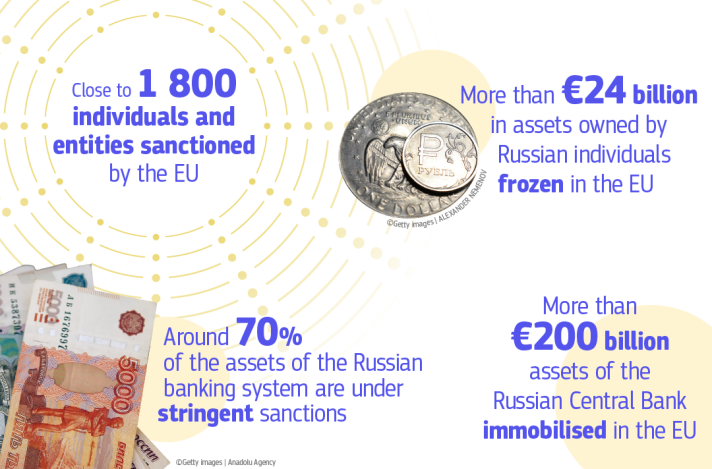
Text version
- Close to 1800 individuals and entities sanctioned by the EU
- More than €24 billion in frozen assets owned by Russian individuals in the EU
- Around 70% of the assets of the Russian banking system are under stringent sanctions
- More than €200 billion of assets of the Russian Central Bank immobilised in the EU
Sanctions have also been adopted by the EU against Belarus in response to its involvement in the invasion of Ukraine. Iran has also been sanctioned in relation to the manufacture and supply of drones used to attack Ukraine. The EU has also enacted a stringent ‘anti-circumvention clause’ that prohibits EU citizens or businesses from knowingly and intentionally circumventing sanctions.
Reconstruction and Ukraine's European path
Ukraine’s future lies in the European Union. This commitment was confirmed during the first-ever College-to-Government meeting and the EU-Ukraine Summit in February 2023. Since June 2022, Ukraine has been given candidate status, on the condition that it would undertake key reforms. Ukraine has progressed on the necessary reform steps outlined in the Commission’s Opinion on Ukraine’s application for membership of the EU.
Despite the ongoing war, the EU has already started to shape the foundations of Ukraine’s reconstruction, and international efforts have been initiated.
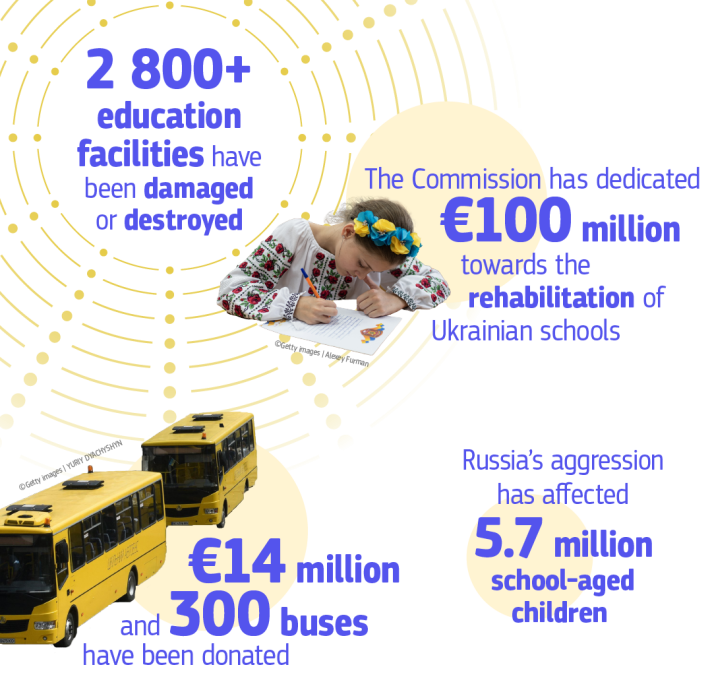
Text version
- More than 2 800 education facilities have been damaged or destroyed
- A €100 million commitment by the EU to fund the rehabilitation of damaged schools
- €14 million and additional support through the 'School buses for Ukraine' campaign across 11 EU Member States, 300 buses have been donated, essential to bring Ukrainian children safely to their schools
- Russia’s aggression has affected 5.7 million school-aged children
- June 2023
Proposed Facility for Ukraine worth up to €50 billion within the EU budget, planned for 2024-2027 to address both immediate recovery needs and medium-term modernisation efforts in view of implementing key reforms on its EU accession track
- January 2023
The multi-agency Donor Coordination Platform was launched to facilitate coordination among international donors and financial organisations to ensure support is provided in a coherent, transparent, and accountable manner
- October 2022
The Commission and Germany, as the then G7 chair, co-hosted the International Expert Conference on the Recovery, Reconstruction and Modernisation of Ukraine in Berlin
Demining technicians from Croatia are already sharing their skills with experts from Ukraine. A remnant of the 1990s war, Croatia is the only EU Member State still demining its land, with €120 million of EU support until 2027. Croatia’s painful experience of war has given it an invaluable skillset to help Ukraine recover and rebuild.
Opening a new phase in the unification of our continent
The shockwaves sent by Putin’s war of aggression immediately reached our six Western Balkans partners. We extended to the Western Balkans the very same solidarity measures that we have taken inside our Union. In December 2022, we saw a historic EU–Western Balkans Summit, with the meeting being held in the region for the first time. In June 2023, President von der Leyen unveiled a new growth plan for the Western Balkans.
Strengthening European defence
Given the continuous and palpable threat from Russia, the EU-NATO strategic partnership has reached new heights of cooperation with the signing of the Joint Declaration on EU-NATO cooperation in January 2023.
Following the conclusion of accession discussions, Finland and Sweden inked the NATO accession protocols on 5 July 2022. Finland officially joined as the 31st NATO Member State on 4 April 2023.

There has also been a boost in EU defence cooperation. In a referendum on 1 June 2022, Danish voters supported Denmark joining the EU’s Common Security and Defence Policy ending Denmark’s 30-year-long opt-out on EU’s defence cooperation.
Since 2021, the Commission has successfully initiated and implemented the European Defence Fund (EDF). Thus far, projects have received more than €3 billion – an investment into the defence technologies and systems of tomorrow. In 2023, the EDF will inject another €1.2 billion into projects in crucial defence domains, such as space situational awareness, countering hypersonic missiles, and the prototype development of a European patrol corvette.

