In response to persistent gender gaps and intersecting inequalities, the EU has intensified efforts to make its budget and policymaking more inclusive. Challenges such as the cost-of-living crisis, care burden disparities and unequal access to digital and green jobs have highlighted the need for sustained investment in gender equality.
As a result, gender mainstreaming is now embedded across major EU policies and funding programmes, including the European Social Fund Plus, the European Regional Development Fund, the Just Transition Fund, Horizon Europe, the CAP and the Neighbourhood, Development and International Cooperation Instrument – Global Europe. These tools promote equal access to resources, economic participation and social protection, along with the prevention of conflict-related violence and participation in peace processes – particularly for women and under-represented groups.
Looking ahead, a new gender equality strategy for 2026–2030 was published in March 2026, following up on the 2024 political guidelines for the 2024-2029 Commission. The strategy not only builds on past achievements but also sets a new benchmark in advancing gender equality, marking a decisive step forward in both ambition and accountability. It responds to emerging challenges with a more robust and forward-looking approach, while significantly enhancing the way financial contributions to gender equality are tracked and measured.
Achievements
The citizens, equality, rights and values programme contributed strongly to the three pillars of the EU gender equality strategy, with 25% of the programme’s budget having gender equality as a primary objective. In 2025, this was mainly driven by the Daphne call, which aims to prevent and combat gender-based violence and violence against children, where EUR 15.4 million out of EUR 23 million contributed to score 2. Overall, approximately 54% of the programme budget was allocated to gender score 1, demonstrating strong gender mainstreaming across programme actions.
Under Horizon Europe, gender equality is a cross-cutting priority. Under the programme, research and innovation contribute to gender equality primarily through the effective integration of the gender dimension in research and innovation content, i.e. the consideration of sex and gender differences in research objectives, methodologies, data collection, analysis and results. The Improve project supports victims of domestic violence – particularly those from marginalised groups – by developing AI tools for reporting, detection and assistance. Moreover, the grass ceiling project (Cluster 6) addresses gender inequalities by co-designing solutions with rural women innovators. Through community hubs, it brings together women farmers, enterprise officers, financial institutions and researchers to identify barriers, co-create support systems and generate new businesses, partnerships and policy recommendations.
With EUR 2.4 million in funding, the European Social Fund Plus supports the project ‘FairPlusService’ in Austria to enhance the professional development and further training of formally low-skilled and unqualified women, fostering equal opportunities and empowerment. The initiative targets women with limited formal qualifications, offering a range of measures to support employment, such as providing compact training and short learning units to stimulate continuous skill development, along with tailored consulting and coaching services for both Austrian companies and the women themselves. The project focuses on key sectors such as trade, tourism, health and social care and education, where advisory services are delivered to bridge skill gaps and promote career advancement. These services are complemented by comprehensive outreach efforts and broad knowledge-sharing initiatives to ensure long-term impact. Overall, the project seeks to promote long-term employment stability, gender equality and labour market participation for some of Austria’s most vulnerable women.
The European Regional Development Fund continues to play a pivotal role in advancing gender equality through a dual approach of gender mainstreaming and targeted interventions. For the 2021-2027 programming period, a total of EUR 19.9 billion has been earmarked for gender-targeted and mainstreaming measures. For example, this support will facilitate the participation of women in research and innovation, embed a gender lens in sustainable urban development and renewable energy transitions and alleviate the disproportionate care burdens shouldered by women by improving access to quality care services.
The Recovery and Resilience Facility supported a wide range of measures contributing to gender equality. These include investments and reforms specifically designed to tackle inequalities based on gender (score 2, contributing to this objective with around EUR 12.4 billion over the lifetime of the Recovery and Resilience Facility) and other type of investments and reforms which are directly or indirectly contributing to gender equality (score 1, corresponding to around EUR 5.7 billion). For example, a measure specifically designed to tackle gender inequalities is the Portuguese reform to combat inequalities between women and men, which awards a seal to companies with a narrow gender pay gap. An example of measures directly or indirectly contributing to gender equality includes investments and reforms improving the access to and the quality of long-term care, for which women traditionally take a disproportionate burden in households in Czechia, Estonia, Spain, Cyprus, Lithuania, Austria, Poland, Slovenia and Slovakia
Under the Instrument for Pre-accession Assistance III, 35% of all actions adopted between 2021 and 2025 have gender as a significant or principal objective and an increasing number of country and regional actions have gender equality as a principal objective. These targeted actions include, amongst others, the fight against gender-based violence in North Macedonia through the ‘We care: United we stand to fight against sexual and gender-based violence’ action, which empowers civil society organisations to encourage positive behavioural change across society for the effective protection of women. In Albania, the EU supports equal participation and leadership through the ‘EU for Gender Equality II – Gender Equality Facility in Albania’, which seeks to promote the consistent application of gender-responsive governance by national authorities, to strengthen equality, combat discrimination, and enhance women's empowerment and human rights, in line with the EU acquis on gender equality.
Under the Neighbourhood, Development and International Cooperation Instrument – Global Europe, between 2021 and 2025, the share of external actions contributing to gender equality and women’s empowerment reached 83% and, of these, 4.7% (about 90 programmes at the country, regional and global levels) had gender equality as a principal objective. For instance, the Advocacy, Coalition Building and Transformative Feminist Action Programme is a EUR 22 million initiative funded by the EU and implemented by UN Women. The programme strengthens women’s rights movements to advocate and work with public authorities on policy and legal reforms and accountability mechanisms to end all forms of violence against women and girls, particularly in contexts of shrinking civic space. In 2025, through the programme, women’s rights organisations and activists shaped more than 20 global and regional normative and policy processes, such as the adoption of the Mercosur Agreement on the Mutual Recognition of Protection Measures for Women in Situations of Gender-Based Violence, the ratification of the International Labour Organization’s Convention 190, and continental justice and accountability frameworks, notably the African Union Convention on Ending Violence against Women and Girls.
How much do we spend?
In line with the 2020-2025 gender equality strategy, the 2021-2027 multiannual financial framework and NextGenerationEU support a range of initiatives promoting women’s labour market participation, work–life balance, care infrastructure, female entrepreneurship and gender balance in education and professions. Dedicated funding also supports civil-society and public institutions tackling gender-based violence.
The Commission developed a methodology to track gender-related spending at the programme level, in collaboration with the European Institute for Gender Equality and informed by the European Court of Auditors’ 2021 report on gender mainstreaming in the EU budget (1).
Since the 2023 financial year, the monitoring of gender expenditure has been enhanced with the inclusion of the gender-disaggregated data available per programme in the programme performance statements (Annex 4 to the present report).
(1) European Court of Auditors, Gender Mainstreaming in the EU budget: Time to turn words into action, Publications Office of the European Union, Luxembourg, 2021, https://www.eca.europa.eu/lists/ecadocuments/sr21_10/sr_gender_mainstreaming_en.pdf.
The EU budget allocation to gender equality scores
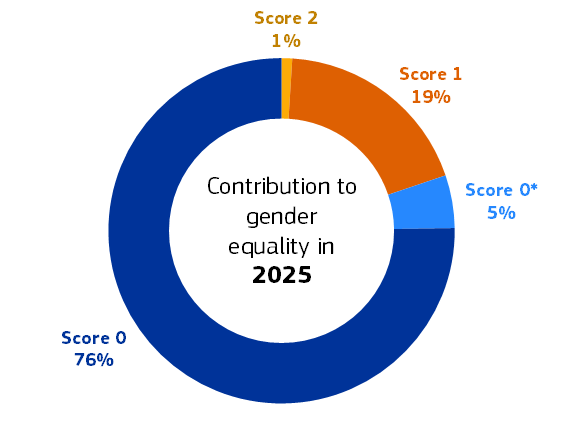
The EU budget allocation to gender equality scores, based on the aggregation of the 2025 interventions qualifying for each score, is outlined below. In line with the methodology, a programme may qualify for one or more gender scores based on the objectives pursued by its respective interventions.
- Score 2: interventions whose principal objective is to improve gender equality corresponded to 1% of the EU budget implemented in 2025 and were included in 13 programmes.
- Score 1: interventions that have gender equality as an important and deliberate objective (but not as the main reason for the intervention) corresponded to 19% of the EU budget implemented in 2025 and were included in 22 programmes.
- Score 0*: interventions that have the potential to contribute to gender equality corresponded to 5% of the EU budget implemented in 2025 and were included in 3 programmes.
- Score 0: interventions that do not have a significant bearing on gender equality corresponded to 76% of the EU budget implemented in 2025 and were included in 53 programmes.
In 2025, almost 20% of the EU budget was allocated to measures supporting gender equality (scores 2 and 1), marking a solid continuation from the previous year and confirming that gender equality remains a strong and consistent priority within the EU’s financial framework. This sustained level of ambition demonstrates that promoting gender equality is not a one-off effort, but an objective that is systematically taken into account year after year in budgetary decisions. It reflects a credible and enduring commitment, alongside a deepening integration of gender mainstreaming across budgetary instruments. More broadly, it shows that the EU is increasingly embedding gender considerations into the core of its spending, ensuring that financial resources are consistently directed toward policies and programmes that advance gender equality across Member States.
In concrete terms, this sustained prioritisation translates into significant financial support: in 2025, the EU allocated a total of EUR 37.5 billion to projects promoting gender equality (gender scores 2 and 1), reinforcing both the scale and the credibility of its commitment in this area.
Overall, the 2025 results reflect continued progress across EU programmes, both in implementation and in strengthened reporting capacity, enabling a more precise and granular understanding of how the EU budget contributes to gender equality. The further reduction in expenditure classified as 0* illustrates sustained efforts to refine methodologies, improve clarity and better identify gender-relevant spending – supporting a more accurate recognition of the EU budget’s gender dimension.
At the same time, 0* has now reached a normal and expected level of 5%, which is a striking contrast to the initial amount reported in 2021, namely 95%. Today, 0* primarily reflects the inherent time lag of certain types of projects where gender impacts can only be demonstrated over time. This confirms that 0* is no longer driven by methodological or capacity gaps, but corresponds to the natural life cycle of interventions, indicating that the system is now functioning as intended. In other words, it is no longer systemic, but rather correspeonds to a natural rate. For example, certain actions where integrating the gender dimension in research and innovation is mandatory, such as research under Horizon Europe, require an ex post assessment to verify how this has been implemented. Until such evidence is available, these actions are assigned a 0*, indicating a likely – but not yet demonstrated – positive impact on gender equality. Today, 0* only concerns these types of projects.
Gender scores as a percentage of the total EU budget in 2025
2021-2025 aggregate trends
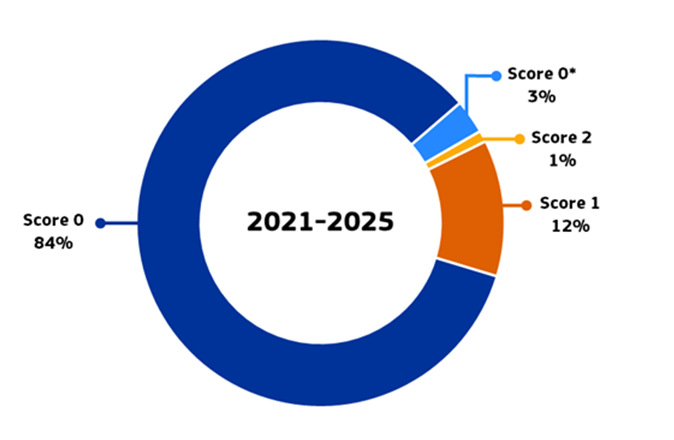
Past expenditure is revised annually through a quality review conducted by the Commission departments, incorporating additional information available on the selected projects. This is particularly the case for measures that were assigned a gender score of 0* in previous years. In this context, the reassessment concluded that, over the 2021-2025 period, 13% of the EU budget expenditure contributed to the promotion of gender (gender scores 1 and 2), amounting to a significant EUR 190 billion over these five years.
At the same time, the share of EU budget under gender score 0* has steadily declined and now stands at just 3% for the four-year period. This reflects the effectiveness of the Commission’s ongoing reassessment efforts, which have contributed to a more precise and clearer understanding of the EU budget support for gender equality. For the 2021-2025 period, 84% of allocations were assigned a score of 0, due to the systematic reassessment of 0* expenditure from 2021 to 2025.
The financial commitments made over this five-year period had a tangible impact across various domains, including employment, social protection and economic empowerment, reinforcing the EU’s role as a global leader in gender equality financing.
Gender scores as a percentage of the total EU budget (2021-2025)
Gender-disaggregated data
This year, for the third time, the programme performance statements (Annex 4 to this report), which provide detailed performance information at the programme level, were enhanced to include the relevant gender-disaggregated information available for each programme. This includes a wide array of gender-disaggregated data aimed at improving the monitoring of the performance of the programme in relation to gender equality. For some programmes, particularly those under shared and indirect management, the availability of gender-disaggregated data is constrained by the programme regulations and the implementation agreements. Looking ahead to the post-2027 multiannual financial framework, Article 44 of the Financial Regulation requires that data relating to performance indicators of financial programmes be gender-disaggregated where feasible, and appropriate in accordance with the relevant sector-specific rules. Building on this, the Commission proposed a Performance Regulation in July 2025. It provides that such data be disaggregated by gender for a set of indicators, where relevant and feasible. This is an important step to improve gender equality monitoring in EU programmes. It also complements the updated better regulation guidelines, which ensure that future ex ante impact assessments of relevant spending programmes consider gender equality from the outset.
Examples of gender-disaggregated data reported in the programme performance statements (Annex 4 to the Annual Management and Performance Report)
- Under the Recovery and Resilience Facility, Member States report gender disaggregated data for results and outputs achieved with Recovery and Resilience Facility support within common indicators 8, 10, 11 and 14. For example, research facilities supported by the Recovery and Resilience Facility employed 34 900 male and 23 400 female full-time equivalent researchers in 2025 (common indicator 8). So far, participants in education and training supported by the Recovery and Resilience Facility amounted to a total of 12.9 million participants across all age groups. Out of the total, 7.7 million females and 5.2 million males were reported (common indicator 10). The total number of 7 million people in employment or job-searching activities supported by the Recovery and Resilience Facility is subdivided into 3.7 million females and 3.3 million males across all age groups (common indicator 11). The number of young people aged 15-29 receiving support from the Recovery and Resilience Facility amounted to 863 200 males and 893 400 females (common indicator 14).
- Under Horizon Europe, as of January 2026, women coordinated 32% of Horizon Europe projects (6 281 women). There are large variations across the programme: the share of women is higher in social-science-oriented actions (Cluster 2: 45%) and lower in industry-focused ones (Cluster 4: 23%). Women represent 53.1% of members of Horizon Europe boards and expert groups, with 55.6% in official expert groups (70 women) and 49.3% in special groups (40 women). Among Horizon Europe researchers, women accounted for 38.3% (101 142), compared with 61.6% for men (162 705), while 0.05% identified as non-binary (128).
- Under Erasmus+, in 2024, 60% of the provided mobility opportunities were taken up by women. The gender distribution varies depending on the field of education; adult education has the highest percentage of women (69.3%), followed by school education (65.3%), higher education (60.4%), youth (57.6%), vocational education and training (54.3%) and sport (41.7%)
- Under the CAP, the total number of farmers receiving direct support (provisional data for 2024) was 5 604 178, of which: women: 1 768 426(31.6%); men: 3 553 350(63.4%); non-binary: 250 (0.0%); no prevalence:209 340(3.7%) and prefer not to say: 72 812(1.3%).
- Under the European Social Fund Plus, all common indicators on participants are broken down by gender. By the end of 2025, 16.0 million participants had been supported, of whom 8.4 million were women, 7.5 million were men and 0.1 million were non-binary.
- Under the Instrument for Pre-accession Assistance III, 393 418 people directly benefited from EU-supported interventions that aim to reduce social and economic inequality. Available sex-disaggregated data indicates that at least 202 532 were female and 191 068 were male.
- Under the humanitarian aid programme, the percentage of beneficiaries disaggregated by gender in 2025 is as follows: 50% female, 42% male and 8% unknown (1).
(1) Number of beneficiaries by age and sex reached by humanitarian aid operations available in EVA actions operational data (such data reflect information encoded in Fiche Opérationnelle and in the European Hospital and Healthcare Federation).
Support gender equality in the 2028-2034 long-term budget
During the 2021–2027 multiannual financial framework, gender budgeting was strengthened through the introduction of a dedicated expenditure-tracking methodology in 2021 and via mainstreaming across some of the EU budget programmes. This progress resulted in around 13% of the EU budget over the 2021–2025 period supporting gender equality. At the same time, there is clear scope for further progress, as a large majority of expenditure (around 84%) remains classified under score 0, indicating no identified contribution. This reflects, in part, inconsistent provisions across programmes, including on monitoring, limited data availability on gender equality, along with the limited integration of gender equality considerations in impact assessments underpinning the 2021-2027 programmes’ basic acts. These limitations have constrained the overall effectiveness of gender budgeting and highlight the need for a more robust and harmonised EU budget framework to support and monitor gender equality objectives.
In response to these challenges, the Commission has proposed the Performance Regulation for the 2028-2034 multiannual financial framework. Under the Commission’s proposal, gender equality will remain fully integrated as a horizontal principle across EU budget programmes, in line with the requirements from the Financial Regulation. It will allow to reinforce support for objectives such as equal access to the labour market, fair working conditions, women’s entrepreneurship, participation in research and innovation and the fight against gender-based violence.
For the first time, the Performance Regulation introduces binding, horizontal rules to operationalise gender equality across all management modes, ensuring that gender equality considerations are integrated throughout the policy cycle – from planning to implementation and evaluation. It also strengthens monitoring and accountability by requiring gender-disaggregated data in performance indicators where relevant and feasible. In addition, it introduces an enhanced expenditure tracking methodology, building on lessons from the 2021-2027 period, which classifies expenditure according to its contribution to gender equality (scores 2, 1 and 0). Dedicated gender equality guidance will support the implementation of the tracking methodology.
Overall, the proposed framework for the 2028-2034 multiannual financial framework elevates gender equality as a cross-cutting principle across all EU funding programmes, strengthening its integration into the design, implementation and monitoring of EU expenditure. It aims to ensure that gender equality remains a central driver in the implementation of the EU budget.